

The Acting District Director of the National Disaster Management Organization (NADMO) in Bongo District of the Upper East Region, Patrick Anamoo Akuntubgo has issued a passionate call for stakeholders to prioritize funding for disaster prevention rather than waiting to respond after catastrophes strike.
Speaking at the commemoration of the International Day for Disaster Risk Reduction on Sunday, Mr Akuntubgo emphasized the urgent need to shift from reactive emergency responses to proactive resilience-building measures.
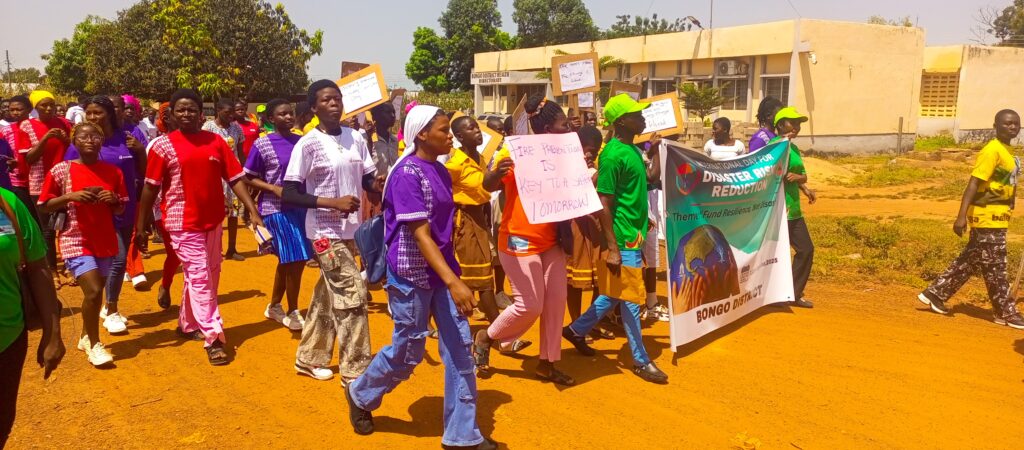
As part of the celebration, NADMO together with District Assembly staff, CAMFED members, youth, and residents of the district took a walk through the principal streets of Bongo with placards bearing campaign inscriptions to raise awareness about disaster risk reduction.
“Disasters do not wait. They strike with speed and with upsetting cost. But the good news is that disasters may be sudden, but they are always predictable,” Akuntubgo told the gathering.
This year’s celebration, themed “Fund Resilience, Not Disasters,” resonated deeply with the challenges faced by communities in Bongo District, where climate-related risks such as erratic rainfall, floods, and drought continue to threaten lives and livelihoods.
The NADMO director challenged the conventional approach of mobilizing resources only after disasters occur. “Too often, resources are only mobilized after a disaster has occurred. Aid comes in when floods destroy homes. Donations are collected when drought wipes out crops. But this is not sustainable,” he stated.
Mr Akuntubgo posed critical questions to policymakers and stakeholders: “What if we invested that money before the disaster? What if those funds went into building stronger houses, training our youth in emergency response, restoring our degraded lands, or building dams and irrigation systems to withstand climate shocks?”
He outlined NADMO’s commitment to transforming its operations from merely responding to disasters to actively preventing and reducing the risks that cause them. The organization’s initiatives include strengthening community education campaigns, training disaster volunteer groups, collaborating with local authorities and youth groups, working with schools to establish disaster preparedness clubs, and engaging development partners to channel resources to vulnerable communities.
To policymakers, Mr Akuntubgo urged them to make disaster risk reduction a budget priority. He called on donors and development partners to channel resources toward long-term resilience rather than just emergency relief. Community members were encouraged to embrace safer practices and participate in local preparedness efforts, while the youth were challenged to become champions of climate action and environmental stewardship.
“Let the world know that in Bongo District, we will not wait for disaster to strike. We will prepare. We will plan and above all, we will invest in resilience,” the acting director declared.
He acknowledged that Bongo District faces unique vulnerabilities, including both climate-related risks and human-induced hazards such as bushfires and poor waste management. While praising the resilience of the local population, he insisted that “their resilience must be matched with resources, planning, and political will.”
The NADMO director emphasized that disaster risk reduction should not be viewed as a cost but as an investment, coining the phrase “prevention pays” to drive home his message.
In his conclusion, Mr Akuntubgo expressed hope that the International Day for Disaster Risk Reduction would mark a turning point rather than just another day of speeches and slogans.
“Let this be a moment where we choose to put our resources where they matter most: into the hands of the communities, into prevention and more importantly into resilience,” he said, as he called for collective action to build a future where communities are “not victims of disasters, but designers of their own safety and survival.”