
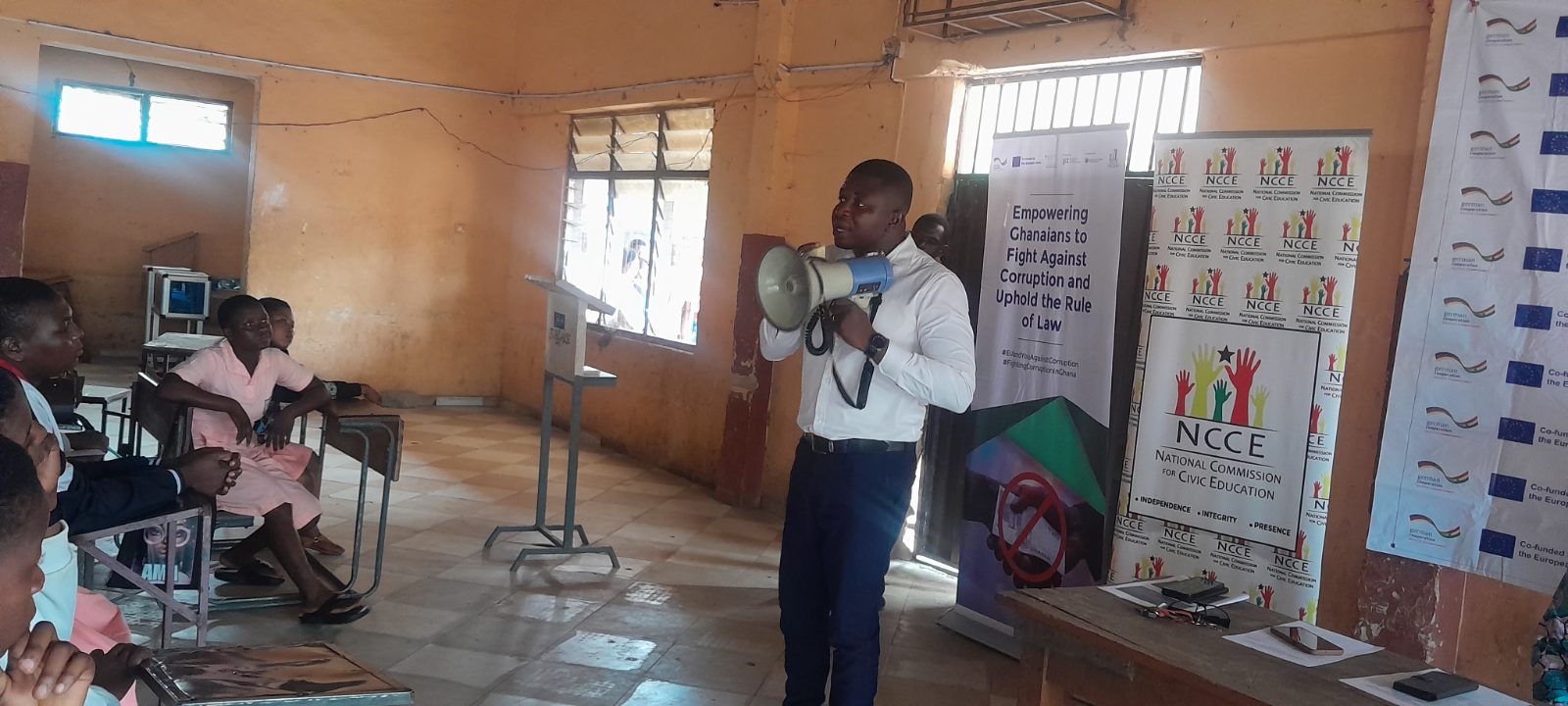
The Commission on Human Rights and Administrative Justice (CHRAJ) investigator, Prosper Atubiga, has told students of Bongo Senior High School that they do not need to wait until adulthood to become ethical leaders.
Speaking during a civic engagement programme organized by the National Commission for Civic Education (NCCE) at the school, Atubiga urged the students to take immediate action as Youth Ambassadors for Integrity by practicing ethical leadership, avoiding conflicts of interest, and fighting corruption in their schools and communities.
The programme, held under the Participation, Accountability and Integrity for a Resilient Democracy (PAIReD) initiative, was sponsored by GIZ and the European Union. The PAIReD programme is implemented by the NCCE to empower citizens to actively participate in governance processes and demand accountability from duty bearers.
Mr Atubiga defined ethical leadership as leadership guided by moral principles, values, integrity, fairness, accountability, honesty, and respect for others. He emphasized that ethical leaders make decisions based not only on legality but also on what is morally right and beneficial to society.
“Ethical leadership simply means doing the right thing even when nobody is watching, and even when it costs you something,” Atubiga said.
He listed key characteristics of ethical leaders as integrity, transparency, accountability, fairness, courage, respect for others, and truthfulness. He noted that ethical leadership builds public trust, promotes good governance, reduces corruption, encourages professionalism, and protects human rights.
The CHRAJ investigator explained that young people can become ethical leaders by being honest always, rejecting the “protocol” mindset that encourages cheating and exploitation of juniors, choosing good friends who encourage positive behavior, respecting rules and authority, using social media responsibly, speaking up against wrongdoing through proper channels, and leading by example.
Mr Atubiga also educated the students on conflict of interest, describing it as a situation where a person’s personal interests clash with their official duties. He cited examples including nepotism in recruitment, misuse of government property, and favoritism in decision-making.
“A public officer shall not put himself in a position where his personal interest conflicts or is likely to conflict with the performance of the functions of his office,” he quoted from the 1992 Constitution, Article 284.
On influence peddling, Atubiga described it as using one’s position, authority, or access to powerful people to obtain favours, benefits, contracts, or jobs in exchange for money or future favors. He cited examples including politicians influencing police investigations, businessmen offering to fund election campaigns in exchange for contracts, and community leaders pressuring school administrators to admit unqualified relatives.
“It’s not what you know, it’s who you know,” he said, illustrating how influence peddling operates.
Mr Atubiga presented a case study of a student discovering that PTA dues meant for library books were being used to buy furniture for the headmaster’s office at inflated prices from a company owned by the headmaster’s wife. He used the scenario to illustrate how conflict of interest manifests in educational institutions.
He informed the students about accountability institutions in Ghana including CHRAJ, which investigates complaints against public officers; the Economic and Organized Crime Office (EOCO), which investigates economic and organized crime; the Auditor General, who checks government spending; the NCCE, which educates citizens on rights and responsibilities; and the Police CID, which investigates criminal matters including corruption.
The CHRAJ investigator emphasized that conflict of interest, influence peddling, and corruption destroy trust, fairness, and national development, while ethical behavior strengthens society. He encouraged the students to report corrupt practices to the right authorities and assured them that they are protected when they report wrongdoing through proper channels.
Mr Atubiga concluded by reminding the students that integrity is doing the right thing even when no one is watching, and that they have the power to build a better Ghana through honesty, accountability, fairness, and integrity.