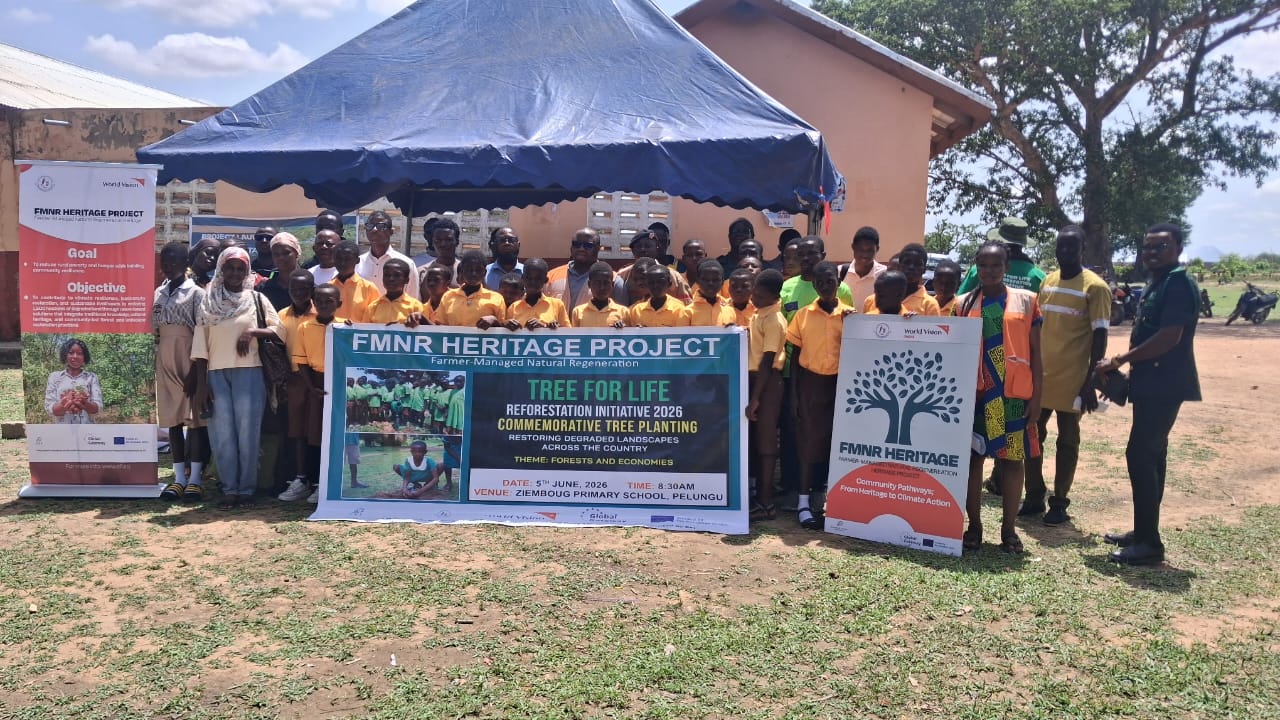
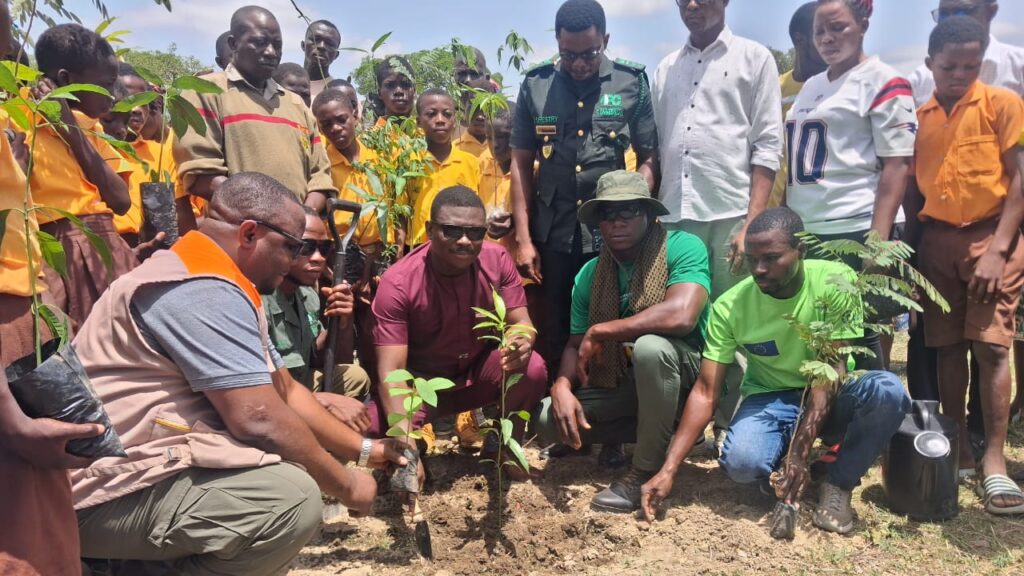
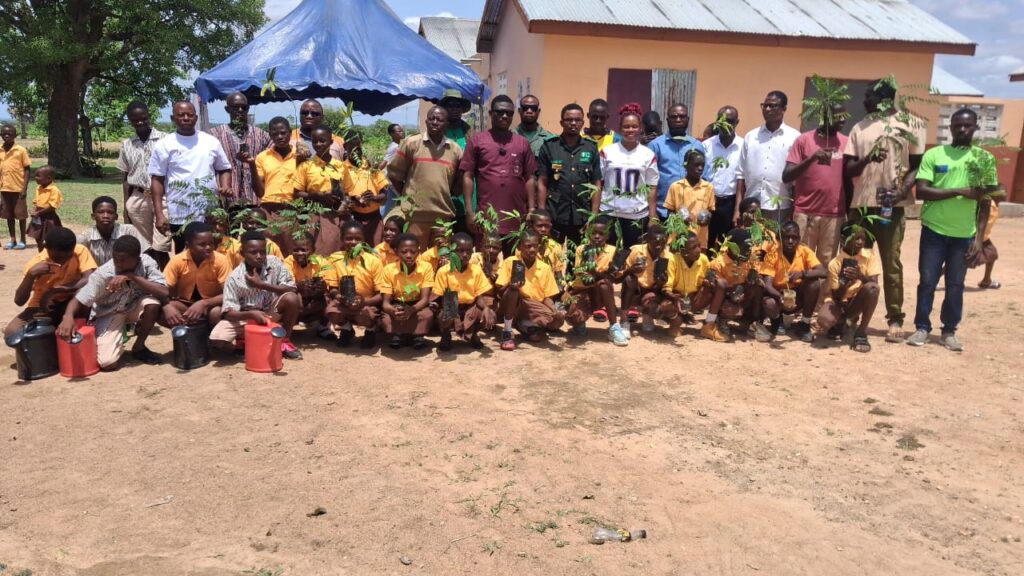
World Vision Ghana has led students, district leaders, education sector stakeholders and community leaders to plant 100 trees at the Ziemboug Primary School as part of the Tree for Life Restoration Initiative.
The Tree for Life initiative is a national reforestation campaign in Ghana aimed at planting over 30 million tree seedlings to restore degraded landscapes, fight climate change, and reclaim lands damaged by illegal activities.
Held under the theme: “Forests and Economies” the Tree For Life Initiative, aligns well with World Vision Ghana’s efforts to restore 1,500 hectares of land with a Farmer Managed Natural Regeneration Project in the Nabdam District of the Upper East Region.
The project which is expected to last 2 years, targets 10,000 farmers and is aimed at sustaining and building a climate resilient Nabdam District by strengthening landscape governance structures, using nature-based, community-led approaches that integrate and revive traditional ecological knowledge and cultural heritage systems.
FMNR is the Systematic regeneration, management, and maintenance of farmer-selected trees and shrubs: living stumps, root sprouts, or seeds that already exist in the soil; it is characterized as a low-cost, simple way for farmers to increase the number of trees interplanted with annual crops in the fields.
Farmer Managed Natural Regeneration (FMNR) comprises a set of practices used by farmers to encourage the growth of native trees on agricultural land. FMNR is widely acclaimed to ensure a number of positive impacts, including increasing agricultural productivity through soil fertility improvement and feed for livestock, incomes, and other environmental benefits.
This approach is widely embraced in Africa as a cost-effective way of restoring degraded land and overcoming the challenge of low survival rates associated with tree planting in arid and semi-arid areas.
Available data suggests that 13% of Ghana’s population is affected by drought, especially in Northern Ghana, with the country losing an estimated 95 million dollars to drought.
With deforestation affecting over 315,000 hectares of farmland per year, Farmer Managed Natural Regeneration is considered a more viable option to ensure a sustainable environment
Joseph Edwin Yekabong, Bawku Cluster Area Programme Manager who spoke during the Tree For Life Initiative last Friday (June 5, 2026) at the premises of the Ziemboug Primary School on behalf of Rexford Bugre, Northern Regional Operations Manager,World Vision Ghana, described the act of planting trees as one that is planting hopes, nurturing resilience and investing in a more sustainable future.
“You would all agree with me that today’s event goes beyond the simple act of planting trees. We are planting hope, nurturing resilience and investing in greener and more sustainable future our children. Through the FMNR Project, World Vision Ghana remains committed to restoring degraded lands and conserving biodiversity.”
He said through the FMNR Heritage Project, World Vision Ghana remains committed to restoring degraded lands as he urges school authorities not to use the watering and nurturing of the trees as a punishment since that will discourage the children from being interested in nurturing the trees.
“Measures have been put in place to ensure that regular watering, monitoring and protection of these trees especially, during the dry season is done. Let me use this opportunity to call on the school authorities. Do not let the watering of the trees be a form of punishment for students.” He admonished.
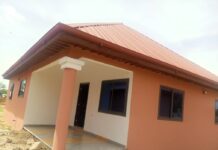
Jonas Bugre, FMNR Heritage Project Manager, World Vision Ghana, observed the devastation caused by climate change in the distruct as he reflects on the havoc done to a school under construction by a rainstorm.
“It is so important because we all see the harm that climate change is visiting on us as human beings and on livelihoods. A typical example is the roof that has been takeoff by a rainstorm. A school is under construction but a heavy storm was able to take off the roof. If we had trees around the school, I’m sure it would have been better.”
He urged the students, teachers and community leaders to ensure the trees are nurtured to grow.
“It should not be said in future that a tree was planted here, a tree was planted here but we should see the trees growing”. He added.
Speaking at the event, the District Chief Executive for Nabdam, Francis Tobig, observed that Ghana’s forests, river bodies and farms are under pressure.
According to him, every school and health facility in the district will receive tree seedlings. He added that the district plans to introduce an award scheme for institutions that protect their trees to grow.