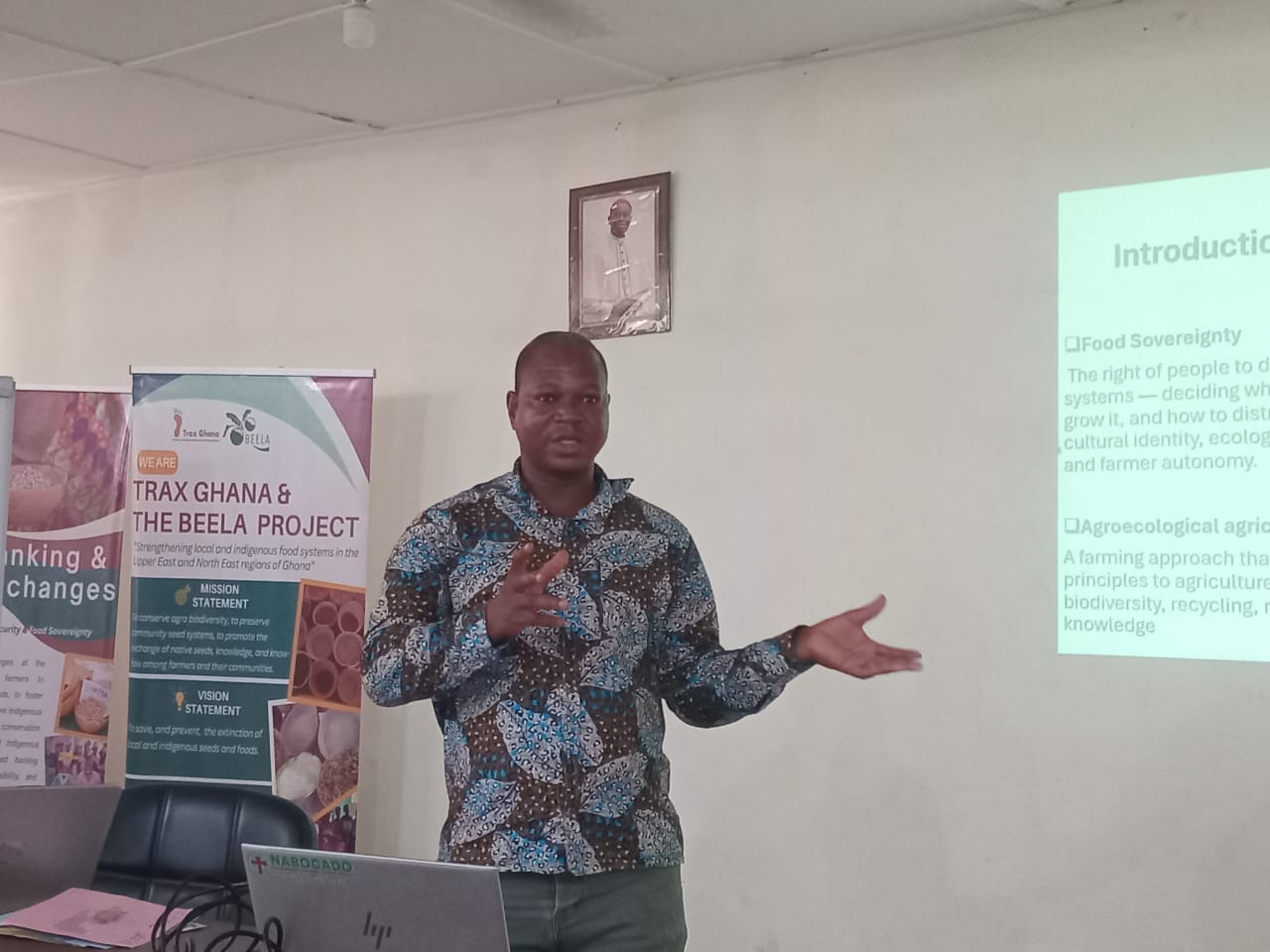
The Programme Director for Livelihood and Agriculture at NABOCADO, Dominic Avea Aniah, has called for stronger efforts to preserve indigenous seed systems, warning that overreliance on hybrid and foreign seeds threatens Ghana’s food sovereignty, cultural identity and environmental sustainability.
Speaking during a media engagement on indigenous seed systems and food sovereignty organized by Trax Ghana in collaboration with NABOCADO and the Beela Project, Mr. Aniah said indigenous seeds remain essential to the survival of local communities.
“Food sovereignty is looking at us having that decision to ourselves that I want to eat this food, I want to prepare this meal, I want to distribute this, and I want to cultivate it,” he said.
Mr. Aniah explained that hybrid seeds are developed by combining traits from different plants to improve drought tolerance, pest resistance and productivity, while foreign seeds are varieties introduced from outside local farming communities.
According to him, increasing dependence on imported and hybrid seeds could eventually wipe out indigenous crop varieties and weaken community seed systems across northern Ghana.
“If we continue to use hybrid seed and foreign seed, it will come to a time that indigenous seeds will no longer be in existence,” he warned.
He said indigenous crops such as millet, sorghum and local rice varieties are deeply tied to the culture, food systems and traditions of local communities, especially in northern Ghana.
“You can imagine going to a funeral and instead of preparing local meals, everything becomes rice. The identity of us as Frafra people will be lost,” he said.
Mr. Aniah also cautioned that hybrid seed systems create dependency because farmers are often unable to preserve and replant harvested seeds without losing productivity.
“It means you have to always wait for the companies that are producing seeds to supply you. You do not have control over when to plant and what to plant,” he stated.
He further warned that monocropping and heavy use of fertilizers and agrochemicals associated with hybrid seeds contribute to biodiversity loss, soil degradation and water pollution.
According to him, indigenous crops are better adapted to local environmental conditions and require fewer external inputs, making them more resilient during droughts and fertilizer shortages.
He referenced recent challenges linked to drought and fertilizer scarcity following the Russia-Ukraine conflict, saying farmers practicing agroecological farming methods recorded better yields than those dependent on chemical-intensive agriculture.
Mr. Aniah also expressed concern that younger generations are gradually losing indigenous farming knowledge, including seed selection and preservation techniques.
“What knowledge will you pass to your son who is going into farming? Most of our young generation do not know how to select seed from the farm,” he said.
He called for increased investment in community seed banks, farmer-led seed improvement initiatives and policy reforms that recognize farmer-managed seeds as legitimate seed sources.
“We need to advocate that farmer seed is also seed,” he stressed.
Mr. Aniah concluded by urging stakeholders to protect indigenous agricultural systems to strengthen resilience and preserve cultural identity.
“Indigenous wisdom is the root of resilience, guiding us towards authentic power,” he said.