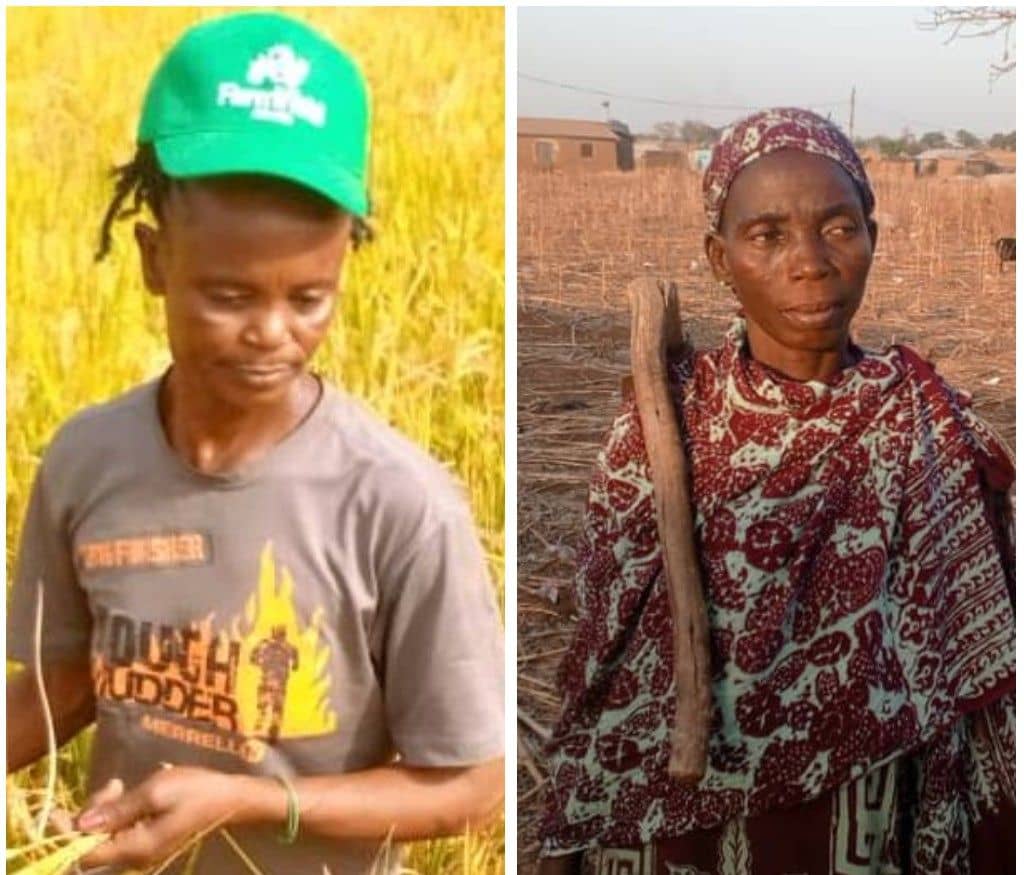
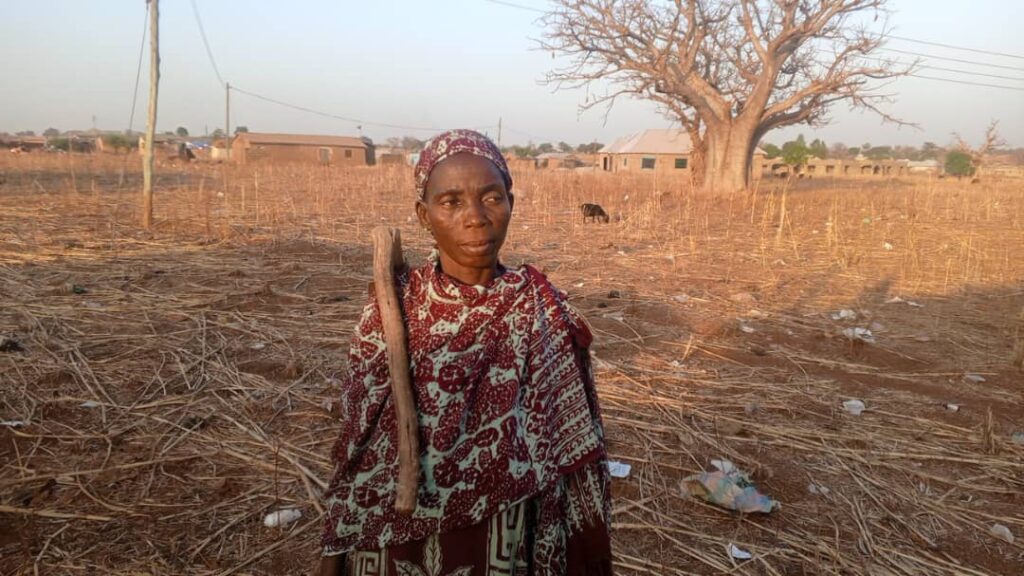
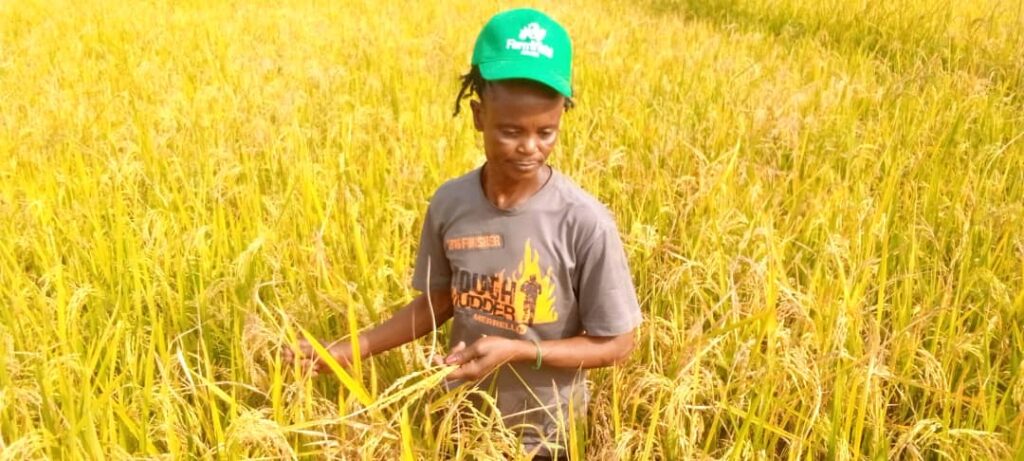
Hajara Abubakar’s hands, roughened by years of toil under the scorching sun, tell the story her words only begin to capture. “When life became difficult in Kumasi,” she recounts, “my husband and I returned home with our children, hoping to survive through farming. A brother gave us land, but disagreements soon followed. Some relatives accused me of taking family land for my husband. The tension became unbearable, and my husband returned to his hometown. I stayed behind alone, determined not to give up.”
Two years ago, Hajara’s husband passed away, leaving her solely responsible for six school-going children. She recalls, voice trembling, “I cried almost every day, struggling to feed my children. There were times I survived by fetching firewood and burning charcoal. I was broken, isolated, and overwhelmed.”
Her salvation came through a hard-won plot obtained after a traditional ritual offering. “I presented a GHS 50 kola nut to the Tindaana, and they gave me a piece of land here in Nungu in the Talensi District. That land saved my family. Today, farming is the only reason my children are still in school, one in nursing training and another in teachers’ training college. I wish our traditions would change so women can own land, because without land, a woman and her children are left to suffer.”
Farming on Borrowed Ground
Hajara’s story is echoed across the Upper East Region. Awumbeere Janet Akupoka, a 50-year-old widow and farmer from Yikene, describes her life-long devotion to farming: “I have been farming as long as I can remember. Growing up, my mother farmed, so I joined her. Today, farming feeds my children and pays their school fees. I rarely buy food; we live on what I grow.”
Yet, land ownership remains elusive. Janet explains, “I do not own land. I either beg families and friends or pay landowners before I can farm. In waterlogged or virtually barren lands, landowners demand payment equivalent to tractor services, usually GHS 100–200 or more per hectare, before allowing access.” She adds that machinery and input shortages, including access to tractors and fertilizers, compound the challenge. Other times, it means pouring her labour into abandoned plots, only for owners to reclaim them once the land becomes fertile.
“There was a place like a forest,” she recounts. “I cleared everything, farmed on it for one year, and they took it back. It was very disheartening.”
The cycle repeats: clear, cultivate, lose.
“It feels like you are always using your energy and resources to develop land for others,” she says. “It’s financial and energy draining.”
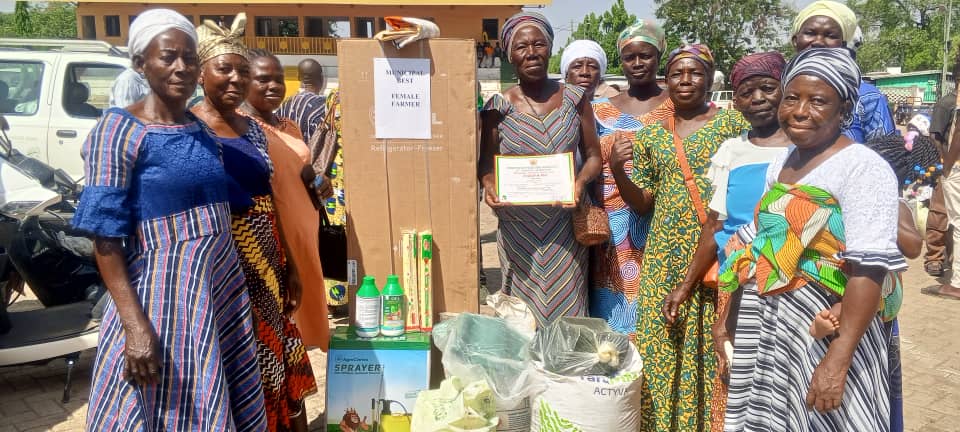
Yet Janet persists. In 2025, she was named Best Woman Farmer in Bolgatanga Municipality during the Farmers’ Day celebrations, receiving a fridge, fertiliser, boots and a knapsack sprayer.
“We used to farm just to feed,” she smiles. “Now we are being recognised.”
In Navrongo, Korania, Janet Atimolga has farmed for over 23 years, cultivating rice, maize and groundnuts. Her experience mirrors that of many women farmers.
“If you look at it well, maybe only 30% of women get land,” she estimates. “The rest is for men.”
She describes how women’s harvests are absorbed into household survival, while some men’s harvests are often sold immediately.
“When women farm, the food is for the children, school fees, hospital bills, feeding,” she says. “When men farm, they sell theirs.”
Janet recounts a painful experience with the Women in Agriculture Platform (WAP). Invited by a chief to farm a 10-acre plot in Kologo, the women cleared thick vegetation, only to find the land secretly reassigned before ploughing began.
“That was when we knew,” she says. “We were offered a different land but…even if we clear it, they will still take it from us.”
The consequences extend beyond income.
“When there is no food, children suffer,” Janet says. “They go out, learn bad behaviours, fall sick, and you don’t even have money to go to hospital.”
Cultural Barriers and Legal Gaps
The patriarchal, patrilineal systems governing land inheritance are pervasive. Moar Karim, a 26-year-old male farmer from Tongo, acknowledges, “When a family has both sons and daughters, the land is given to the male child, while women, especially those who marry into another family, are not entitled to farmland. However, I believe this system should change. Women should be allocated a portion of family land to engage in farming.”
Even traditional authorities see the imbalance. Bonaba Baba Salifu Atamale Lemyarum, Paramount Chief of Bongo Traditional Area, says, “Women are the backbone of agriculture and family survival…Yet, widows are often deprived of their husbands’ land, receiving only small portions while families take the rest. I strongly support equal access to land for women. Since becoming chief, I have educated families to allow women access to land for farming. Women are not competitors to men; they are partners in development.”
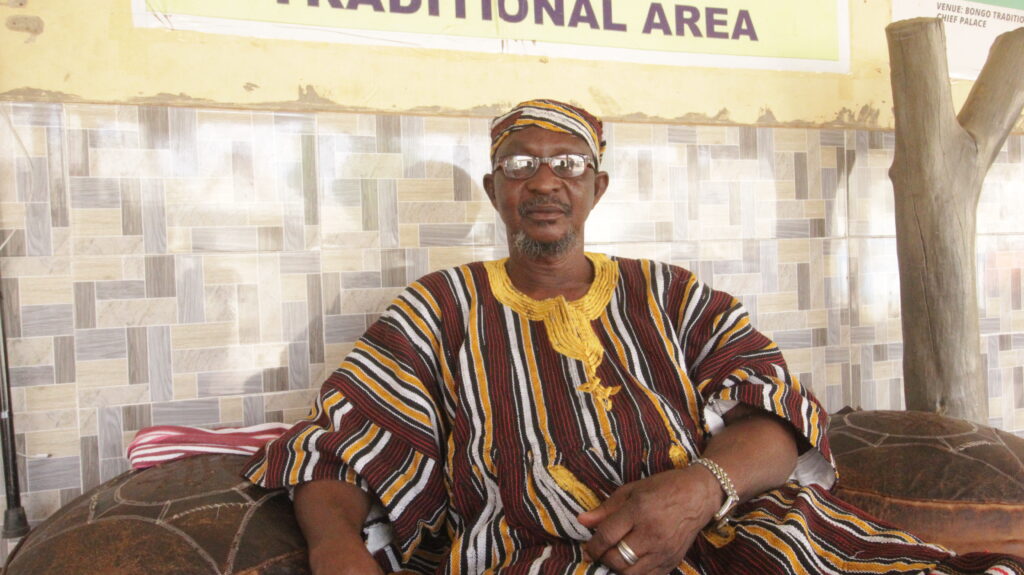
Similarly, Abayeta Ayimbiire, Tindaana of Tindomolgo, stresses that exclusion of women is largely cultural, not spiritual. “There is no taboo forbidding women from owning land. Women’s participation in farming is essential, not only for food production, but for household stability and wellbeing.”
Yet land scarcity threatens all. Ayimbiire notes, “Most farmlands in Bolgatanga township have been sold, leaving little to inherit or distribute. Even lands reserved for schools, hospitals, and roads have been sold. Where land is available, women can still access it through chiefs, tindaanas, or elders.”
Edna Ivey Adabayeri, Senior Legal Officer at the Lands Commission and Registrar of Lands for the Upper East Region, highlights the legal framework. “The Land Act does not explicitly mention women’s rights, it speaks in terms of spousal rights. But this is crucial: if land is acquired during a marriage, both spouses are considered parties to the ownership. If a conveyance is made to one spouse alone, the law presumes it is held in trust for both unless explicitly stated otherwise. Section 47 reinforces that a spouse cannot sell, lease, or transfer land acquired during marriage without written consent of the other spouse. Legally, women are protected. Section 11 prohibits discriminatory practices, meaning any tradition denying women land rights simply because they are women is void. Yet enforcement remains a challenge.”
Edna adds that bridging the gap requires education, proper documentation, and community engagement. “Temporary land permissions, licenses or user rights, should be documented to ensure women can farm securely. Chiefs, tindaanas, and family heads must formalise arrangements, monitor their use, and understand their role is custodial, not personal ownership. Women must have their rightful share of land through education, documentation, and recognition of spousal and customary rights. The law does not discriminate, but customs and lack of education create barriers. Bridging this gap is our shared responsibility.”
The Women Farmers’ Collective Response
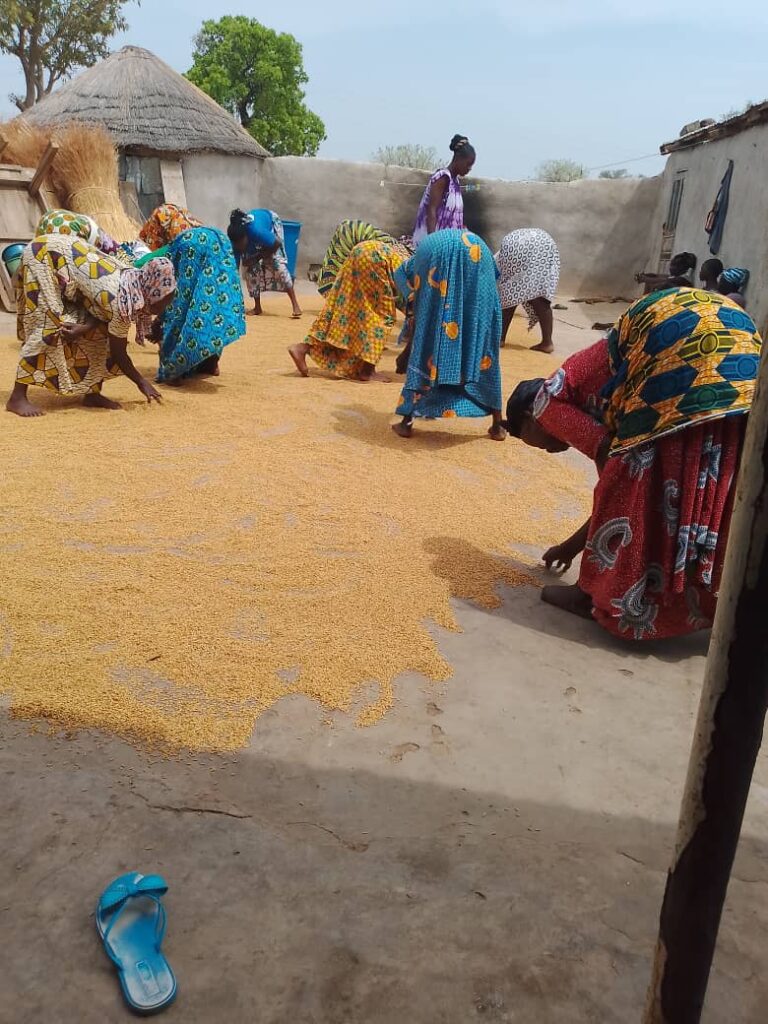
To counter systemic barriers, women are increasingly organizing into groups. Gilberta Akuka, Regional Secretary of the Women in Agriculture Platform, highlights how collective action provides security: “Through advocacy, some chiefs, such as the Bongo and Navrongo chiefs, have allocated communal lands (20–30 acres) specifically for women’s farming groups. Members now confidently engage with district assemblies and agricultural offices, influencing development decisions.”
Akuka supervises the Asakoob Women Group in Tilli, which successfully accessed fertilizer subsidies, input loans, and leadership training. “Forming groups empowers women to be heard, access land, credit, and government programmes. Women are not competing with men; they complement them. When women have land and income, families are more stable, food-secure, and peaceful.”
Collective Efforts and Pathways to Change
Professor David Milla, President of the Milla Institute for Transdisciplinary and Development Studies underscore the structural inequality: “Women do about 70% of agricultural production activities but do not control land or harvest decisions. Land tenure systems deepen poverty and inequality, especially for women. The solution lies in social reform, not simply policy enforcement. Communities should incentivize landowners to lease land to women for five years or more, reducing exploitation and stabilising women’s farming activities.”
Alhaji Zakaria Fuseini, Upper East Regional Director of Agriculture, describes women as the backbone of agriculture but says their impact is undermined by poor access to land and finance. “Women are usually given exhausted lands, and when they improve the fertility, the land is taken back,” he explains, adding that limited credit restricts investment and growth.
He notes that government policies are gradually recognising the role of women in agriculture. Under the Womens Bank and the Feed Ghana Programme, initiatives such as the Akoko Nkiti Nkiti poultry project are designed to support women, who traditionally dominate small-scale poultry production. “There is no household you go to without poultry, and it is mostly championed by women,” he says. The planned rehabilitation of the Doba livestock breeding centre is also expected to provide women with improved breeds to raise productivity and incomes, while proposed financial interventions, including a women-focused bank, could significantly strengthen women’s participation in the sector.
Alhaji Fuseini also highlights the critical role of ActionAid in championing women farmers’ rights, particularly through dialogue with traditional authorities. He credits the organisation with helping women assert land and asset rights in parts of northern Ghana and urges more chiefs to follow examples set by leaders in Bongo and Navrongo. “Supporting women farmers,” he stresses, “is key to sustaining agriculture and rural livelihoods in this region.”
Akuka Yakubu, Regional Programme Manager for ActionAid in the Upper East Region says land ownership inequality remains a major driver of food insecurity and poverty. “When women farm, households benefit the most because women prioritise home nutrition,” he explains. Through Smallholder Women Farmers Networks, ActionAid has helped women collectively secure land leases of five to ten years across several districts, strengthening livelihoods and bargaining power. Yakubu points to tangible progress in communities such as Sakute, Nangode, Damolgo, Damoltindong, Kotintabeg, Gane-Asong, Zanlerugu, Dapoore, Pwalugu, among others. He says sustained community engagement has shown that change is possible.
Despite progress, Yakubu identifies land access as the biggest challenge. “Women want to farm, but securing land is extremely difficult,” he notes, as most depend on temporary arrangements and marginal lands. Still, he says change is possible through sustained engagement with chiefs and family heads. On the Land Act, he concludes that “the challenge is not the absence of policy, but weak enforcement,” calling for simpler laws, local-language education and decentralised land administration to protect women’s rights and reduce conflicts.
The Human and Economic Imperative
According to the Ghana Statistical Service (2023), women constitute over 60% of smallholder farmers in northern Ghana but own less than 20% of agricultural land. Their empowerment aligns with SDG 2: Zero Hunger, SDG 5: Gender Equality, and SDG 1: No Poverty. Land insecurity not only constrains productivity but perpetuates household poverty, malnutrition, and intergenerational disadvantage.
A Call for Change
For Hajara, Janet, and thousands of women across Upper East Ghana, farming is not merely livelihood, it is survival, dignity, and hope for their children. “Without land, women and children suffer. If women have land and income, it will benefit the entire household, men, women, and children,” Hajara concludes.
Empowering women farmers is more than social justice, it is an economic necessity, a community imperative, and a moral responsibility. Ghana’s journey toward equitable development will remain incomplete until women like Hajara can farm without fear, plan for their families, and transform their communities from the soil up.