
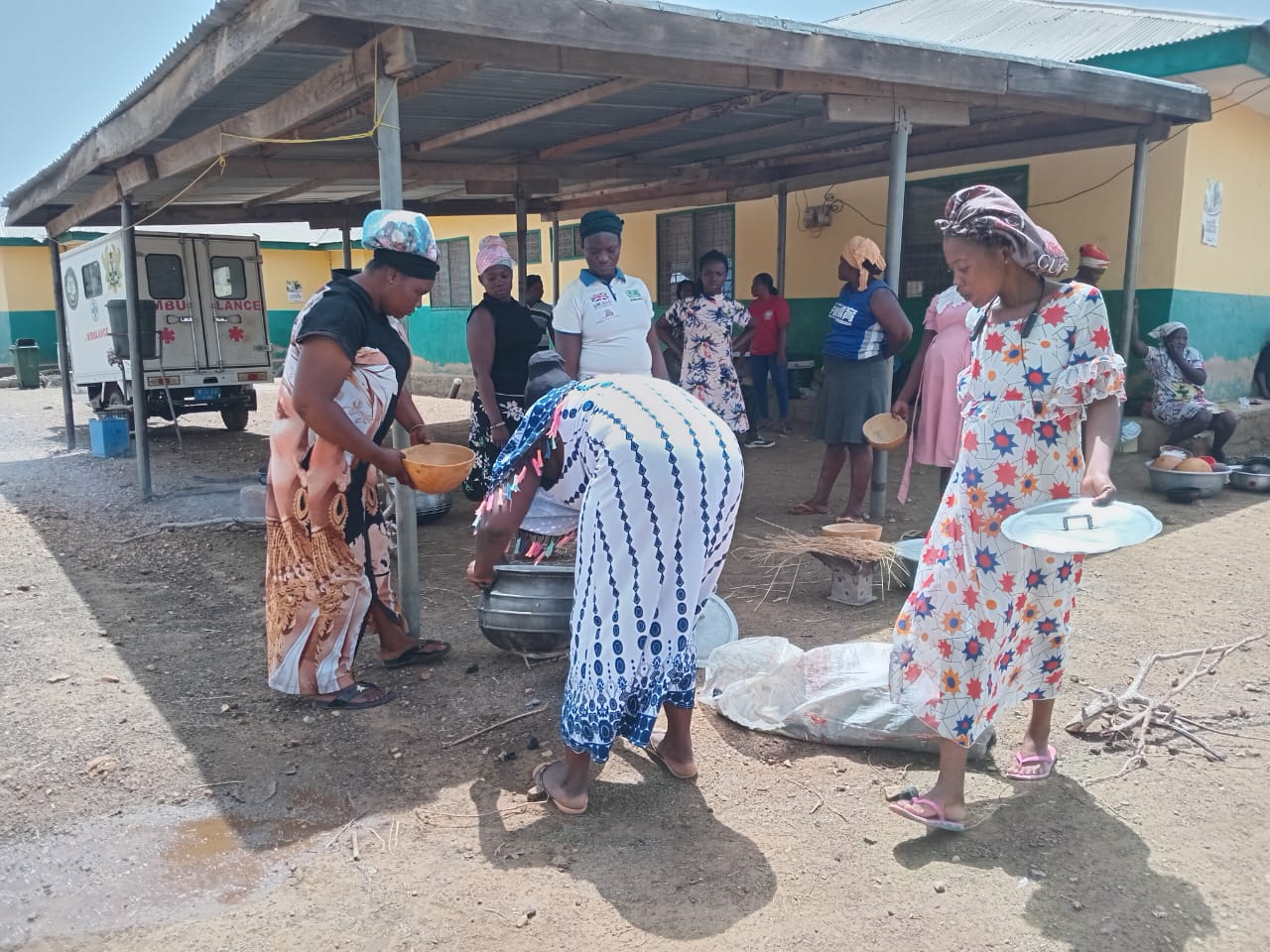
Vida Bugbon has cooked for her family her entire adult life. She knows which leaves make a soup bitter and which give it body. She knows how to stretch a meal when the rains have been poor and the harvest thin. What she did not know, until recently, was that decades of habit had been working quietly against her.
She had been washing her vegetables after cutting them. A small thing. But every cut surface, the trainers explained, is a door nutrients walk out of. Wash first, then cut.
“We have been cooking in the house,” she said, seated beneath the open sky of her community in Ghana’s Upper East Region. “But it is different from what we have learned here.”
Ms. Bugbon is one of dozens of women who have recently participated in hands-on cooking workshops organized by the Widows and Orphans Movement, a civil society organization founded in nearby Bolgatanga in 1993. WOM has long been a lifeline for widows in a region where an estimated 61,725 widows live and where 75 percent are either poor or extremely poor.
But its newest campaign has extended its reach beyond widowhood into the kitchens and food fields of the broader community and into a crisis hiding in plain sight.
Northern Ghana has always been poorer and hungrier than the south. The Upper East Region, which borders Burkina Faso along a flat, sun-hammered savanna, is one of the country’s most food-insecure zones. Government data shows the Upper East Region has 634,293 people with limited access to sufficient and nutritious food.
But food insecurity here is not only about quantity. It is also about what has replaced the old foods.
Over the past generation, processed ingredients, seasoning cubes, packaged condiments, and refined grains have worked their way into daily cooking across rural northern Ghana, filling the space left by traditional crops that have quietly disappeared from kitchen gardens and community farms. Across Ghana, food environments, particularly in poorer areas, are increasingly characterized by cheap, highly processed foods, while nutrient-dense options such as fruits and vegetables have become unaffordable or simply unavailable. The consequences show up in the bodies of children: in northern Ghana, up to 36 percent of children are stunted, 11 percent wasted, and 18 percent underweight, rates far higher than in the south.
It is this quiet double crisis, the erosion of traditional food knowledge alongside the spread of nutritionally hollow substitutes, that WOM’s new campaign is trying to reverse.
The initiative, funded by the 11th Hour Project Food Sovereignty Fund and RSF Social Finance, is being rolled out across several communities including Sakote, Gane-Asonge, and others in the Upper East Region. Its method is deliberately intimate: small groups of women, a fire, a pot, and ingredients sourced from the land around them.
At a recent session in Gane-Asonge, participants gathered to prepare Tubaani, a steamed bean cake made from black-eyed peas, known locally as Gaare, alongside Sagkene, a thick fermented porridge, and soups made from leafy vegetables foraged nearby. These are not exotic dishes. They are foods that grandmothers made. The point of the exercise was precisely that: to demonstrate that what is old can also be what is good.
Alongside the cooking, health educators worked through a curriculum of small, transformative habits. Wash vegetables before cutting, not after, to preserve nutrients lost through the cut surface. Cook for shorter periods; long boiling destroys vitamins. And perhaps most significantly, you do not need seasoning cubes.
“We are taking a lot of seasoning in the house,” Bugbon said, describing her life before the training. “But here we have learned that without it, we can still cook and eat, and it will help our body.”
Earlier sessions held in Sakote surfaced similar insights from a different angle. There, women spoke not just about cooking technique but also about what they had stopped growing. Millet, bambara beans, leafy greens, crops that once anchored the local diet, have gradually ceded ground to purchased staples whose supply depends on cash, market access, and supply chains entirely outside a household’s control. The women in Sakote made clear they understood the vulnerability this created.
What gives the campaign unusual reach is its formal partnership with the Ghana Health Service, a collaboration that bridges the gap between community organizing and clinical authority. Health workers bring the science; WOM brings the trust. In a region where widows and vulnerable women have historically found institutions indifferent or inaccessible, that trust is not incidental. It is the whole foundation.
WOM’s origins speak to why. The organization was founded in Bolgatanga in 1993 by Betty Ayagiba, a nurse who had herself been widowed in 1988, after she observed that widows arriving at the hospital were frequently suicidal or suffering health crises rooted in the dehumanizing widowhood rites imposed on them by their communities. From that narrow beginning, a nurse gathering her colleagues to help, WOM has grown into one of the Upper East’s most recognized civil society institutions, accumulating nearly three decades of relationships in communities that have learned to see it as theirs.
That social capital now allows the organization to do something that top-down nutrition programs often cannot get through the door.
The Ghana Health Service partnership adds a layer of clinical legitimacy to community demonstrations that might otherwise be dismissed as folksy tradition. When a health worker stands beside a pot of Tubaani and explains the protein content of bambara beans, the conversation changes.
Nutritionists and development practitioners have spent years arguing that food sovereignty, the right of communities to define their own food systems, rather than having them defined by global markets, is not merely an ideological position. It is a health strategy. Community-based food demonstrations using locally sourced ingredients have been shown in northern Ghana to improve dietary diversity and promote healthier living when implemented with genuine community participation and sustained follow-through.
What WOM is attempting is an old idea executed with new intentionality: restore the knowledge before it is gone entirely. Seeds, too, are part of the campaign’s concern. Organizers have made clear that preserving indigenous food knowledge and indigenous seed varieties go hand in hand, you cannot cook millet you no longer grow, and you will not grow millet if you have forgotten why it matters.
For Bugbon Vida and the women of Gane-Asonge, the stakes feel both enormous and entirely personal. The training, she said, has already changed what happens in her kitchen.
“What we are doing here is helping us to change,” she said. “We have been cooking in the house, but it is different from what we have learned here.”
She said it without drama, the way someone states a simple fact. The vegetables get washed first now. Less seasoning goes into the pot. The old foods are coming back to the table.
In a region that has spent generations being told its traditions are backward, that may be the most radical act of all.